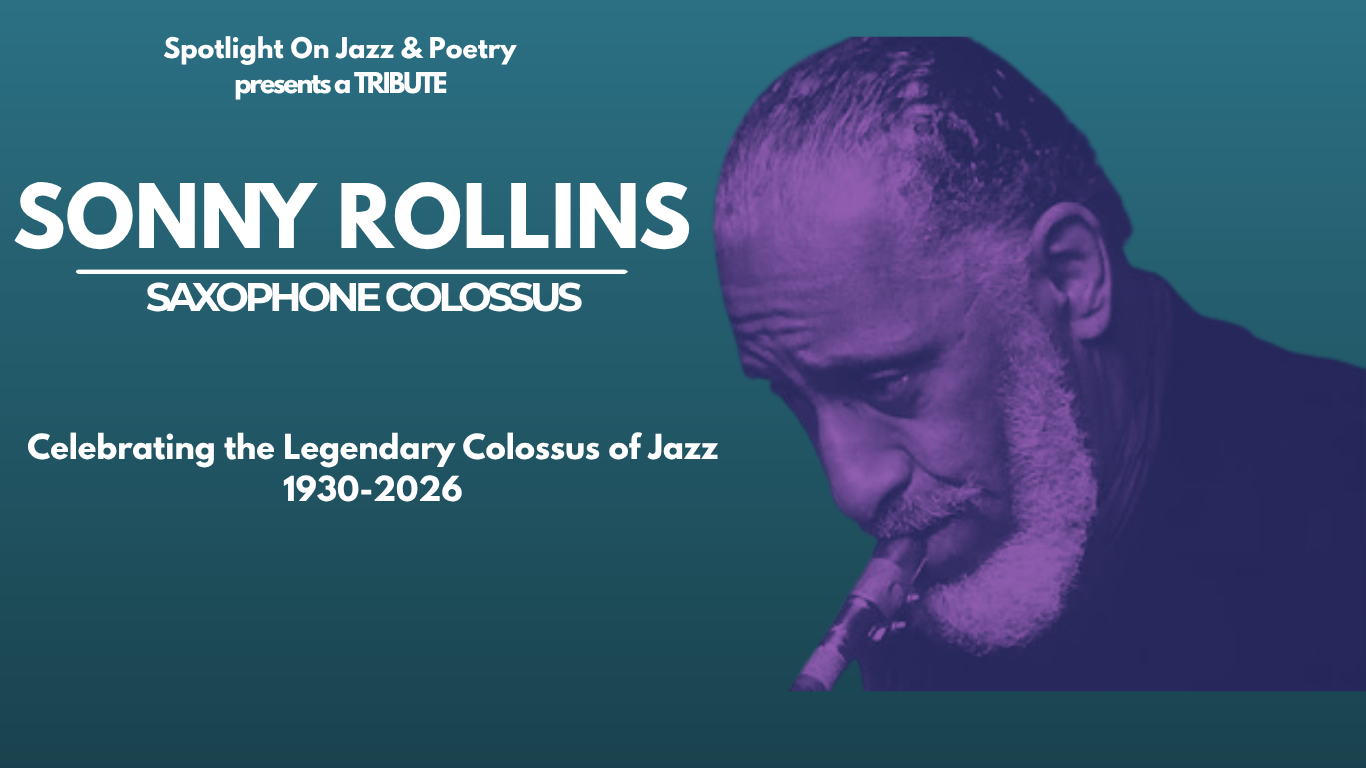
Sonny Rollins
Legendary jazz tenor saxophonist
Walter Theodore “Sonny” Rollins was born on September 7, 1930, in New York City to parents from the Virgin Islands. The youngest of three siblings, he grew up in central Harlem and on Sugar Hill, receiving his first alto saxophone at the age of seven or eight. He was nicknamed Sonny by his grandmother and was mentored by pianist Thelonious Monk.
He attended Edward W. Stitt Junior High School and graduated from Benjamin Franklin High School in East Harlem. Rollins started as a pianist, then switched to alto saxophone after being inspired by Louis Jordan and finally switched to tenor saxophone in 1946, influenced by his idol Coleman Hawkins. During his high-school years, Rollins played in a band with other future jazz legends Jackie McLean, Kenny Drew, and Art Taylor.
In a seven-decade career, Rollins recorded more than sixty albums as a leader. His towering achievements on the tenor saxophone are many and he was one of the most exciting and fiery players in concert.
In the 1950s, Rollins began by serving as a sideman on sessions with Miles Davis, Thelonious Monk, Art Farmer, and the Modern Jazz Quartet. During this time another nickname that stuck with Rollins was “Newk,” Miles Davis recounted in his autobiography that he and Sonny Rollins, wearing a baseball cap, were riding in a taxi. The white cab driver turned around, excitedly pointed to Rollins, and mistook him for the famous baseball player Don Newcombe. Sonny played along telling him how he was going to pitch his next game. Miles thought the incident was hilarious and began calling him “Newk” from that point on.
In late 1955, while living in Chicago, he began one of his most fruitful band affiliations when he stood in for Harold Land in the superb Clifford Brown- Max Roach Quintet at the Bee Hive club. He remained a regular member until Brown’s tragic June 1956 death from an auto accident.
Rollins continued to record, mainly for Prestige, where his output was some of the finest music recorded in the mid-1950s on any label. Among the highlights during this period were Tenor Madness, which included an encounter with John Coltrane; Saxophone Colossus, a sparkling album that introduced his most noted composition, “St. Thomas,” which honored his parents’ Virgin Islands roots; and Way Out West, which took seemingly mundane songs like “I’m an Old Cowhand” and spun them out with extraordinary improvisations.
By 1959, Rollins had grown impatient with the vagaries of the jazz scene and took a hiatus. He would often practice his horn deep into the night on the upper reaches of the Williamsburg Bridge, which crosses the East River from Manhattan to Brooklyn. In 1961 he returned to the scene, refreshed and playing better than ever. He made a series of recordings for the RCA label with musicians such as Jim Hall, Don Cherry, Billy Higgins, and Herbie Hancock, and began his long-term employment of bassist Bob Cranshaw.
In London in 1966, he composed and recorded a soundtrack album for the film Alfie for the Impulse! label, which brought him some popularity beyond jazz audiences. By 1968 Rollins again required a break from the scene, returning in 1971 and since then worked almost exclusively on concert stages. Rollins’ recordings continued to reflect his interest in Caribbean rhythms, particularly the calypso. In 2010, he was elected a fellow of the American Academy of Arts and Sciences and was awarded the National Medal of Arts.
It’s no state secret that Sonny Rollins has never been fond of the recording studio. Never mind that he’s recorded his full share of gems there—not only early, celebrated albums such as Saxophone Colossus and Way Out West, but also digital-era efforts such as Old Flames and This Is What I Do. The man often embraced as the greatest living improviser requires too much creative freedom to start playing, as he puts it, “when the red light comes on.” And his perfectionism makes it difficult, sometimes painfully so, to go through multiple takes in search of what he thinks is the least flawed one.
But in Rollins’s preferred element—on stage, in front of an adoring crowd, free to follow his every impulse and dazzle with his inventions—he is fully at home. And that’s not just because in those situations this iconic tenor saxophonist is unencumbered by time restraints and issues in the control booth. The best thing about performing for him, by far, is seeing how happy his playing makes all the excited people who turn out to see him. The next best thing is making some of those performances—ones “that present parts of me I want to have presented”—available on record to his fans.
Walter Theodore “Sonny” Rollins transitioned on May 25, 2026